
These two are methods worth practicing in this lesson, not sufficient or necessary conditions for success. Resources, opportunities, collaboration, health, and feedback also affect outcomes. In this course, “success” is first defined as: a self-chosen small action happened, evidence remains, and you know how to adjust the next step. It does not use wealth, famous schools, or outperforming others as a unified goal.
Returning to the original 60 minutes
Page 4, original 3 minutes: Use the distinction between problem—need—solution to practice “returning to the start” once. No new terminology lecture is added.
Page 8, original 4 minutes: Write goals, facts, constraints, and assumptions into the AI prompt. Let the AI provide solutions, then verify the premises yourself.
Page 15, original 3 minutes: Keep failure and responsibility, add “how to design self-discipline in advance,” without compressing it into a motivational story recap.
Page 16, original 7 minutes: Write one startup prompt, one distraction adjustment, and a recovery plan after interruption into the original action card. The form is an optional scaffold; in class, fill only the parts relevant to this action. Do not require filling all fields in 7 minutes.
The celebrity source analysis below is for teacher preparation or a separate 10–15 minute extension. It is not counted in the main lesson, and video playback is not default. The screen still uses anonymous scenarios and methods; the source page retains verifiable original titles.
Self-Discipline: Making commitments conditional, bounded, and recoverable
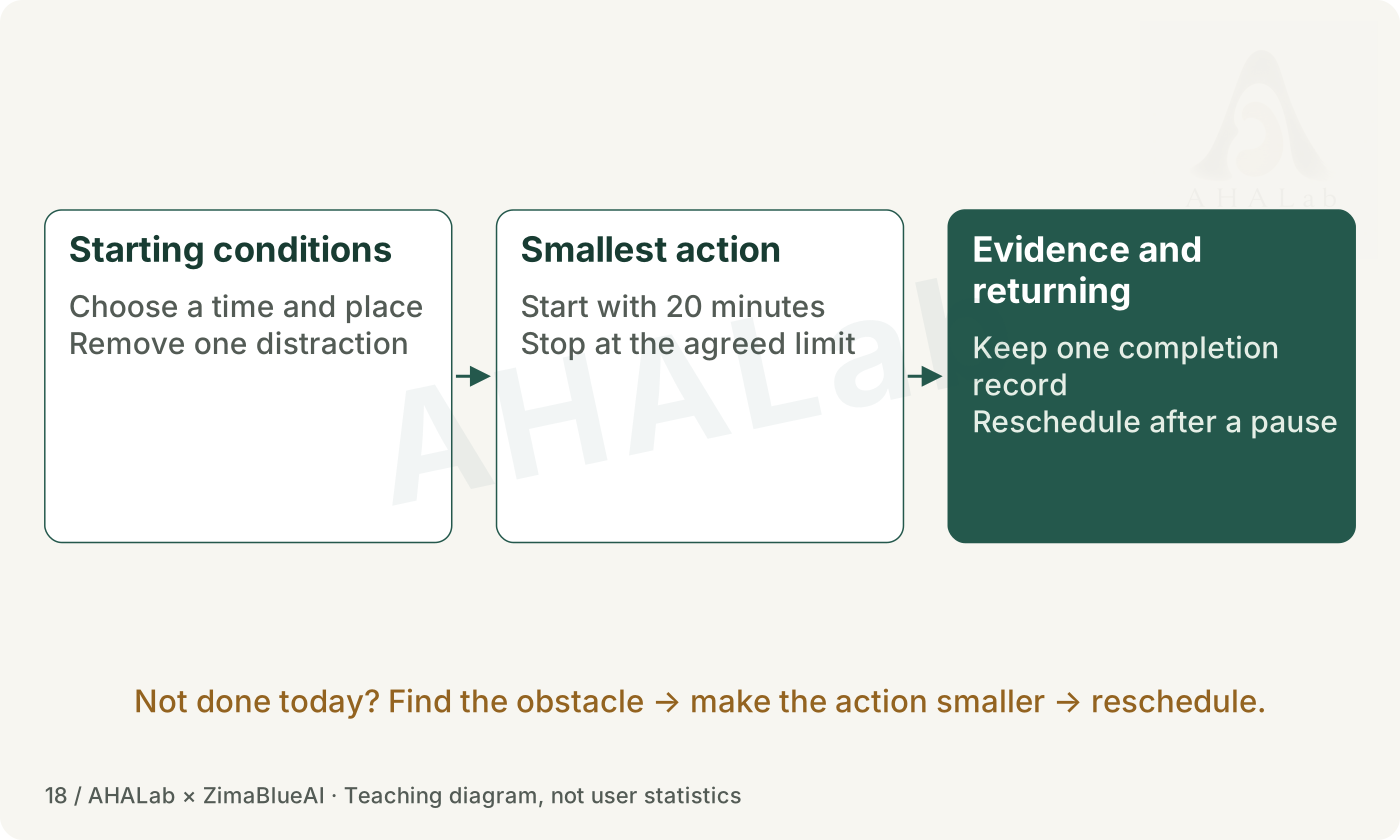
One self-chosen goal → arrange time and place → reduce distractions → complete the minimum action → leave evidence → recover after interruption.
Teaching demonstration: I want to understand where peers easily forget when borrowing and returning items. Tomorrow after dinner, sit at the desk for 20 minutes; first open the paper card template, temporarily mute message reminders; stop after completing two paper cards; ask a voluntary partner to try once. If no one is available, do a peer rehearsal first and mark it; if not done today, explain the blocker first, reschedule once, and do not compensate with all-nighters.
What can be observed is whether the action started, what was delivered, what conditions were encountered, and whether help was sought in time. You cannot judge “he is not self-disciplined” based on one interruption, nor can you judge that a need is established based on continuous check-ins.
Self-discipline also includes stopping: when reaching the pre-set cost limit, involving data that should not be collected, when the other party refuses, or when the body needs rest, stop as agreed. Maintain patience with users, keep room for modifying plans, and do not blindly expand investment due to persistence.
Research reference:Situational Strategies for Self-Control (2016, journal abstract) ↗It proposes that self-control can be supported by choosing or changing situations in advance. This lesson borrows this design approach but does not claim that “20 minutes” or any specific check-in method guarantees success.
First Principles: Not calling a value judgment an essence
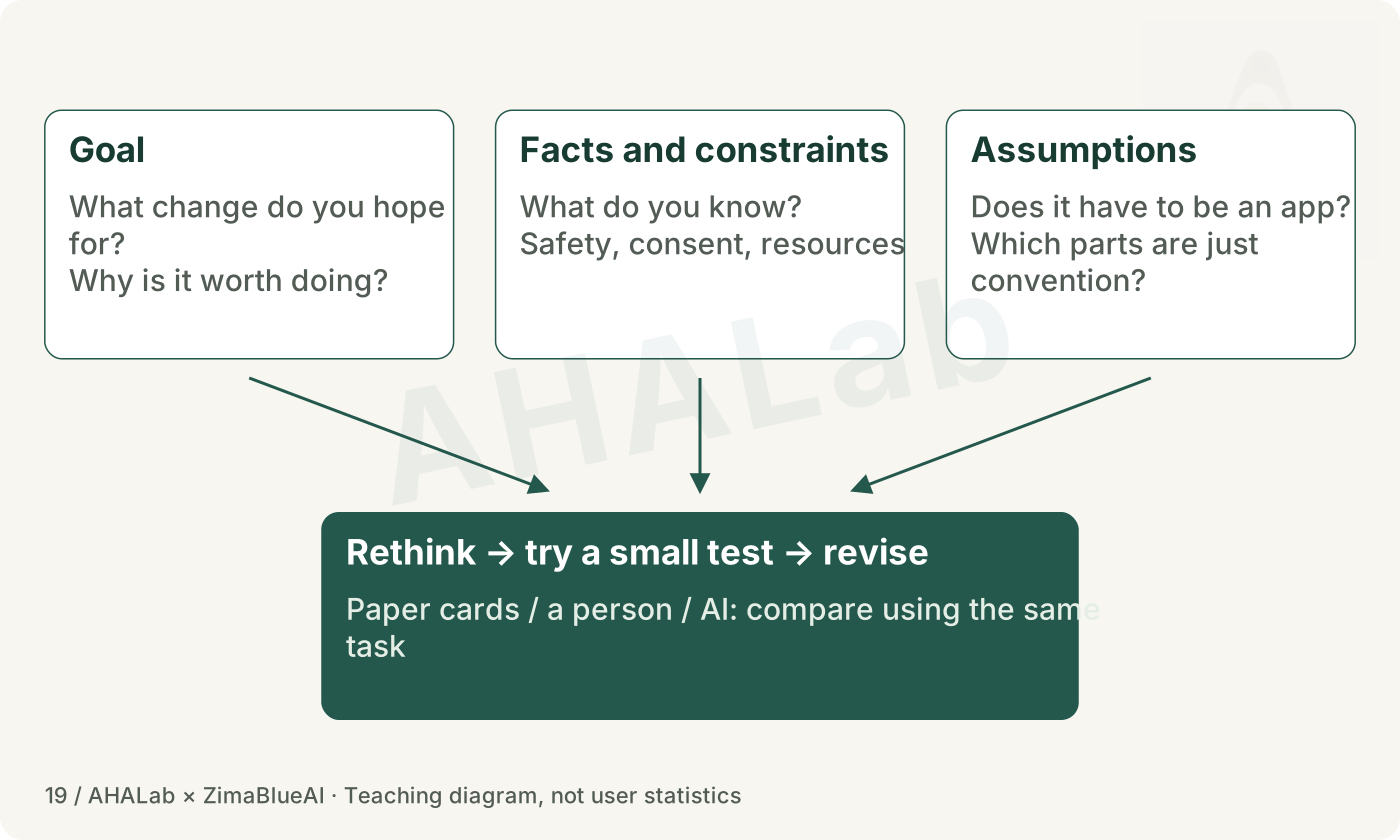
The classroom uses a practical check method: first state the goal, then verify facts and constraints, identify assumptions that can be questioned, reorganize candidate solutions, and revise through small tests. It is a teaching scaffold to help thinking, not a law that derives all life answers.
| Check | Teaching adaptation for Shiguang Huaxia | Common points of confusion |
|---|---|---|
| Goal | People who want to speak can do so at their own pace | “Making a book” might be a solution, not the goal for every user |
| Known facts | Being able to speak does not mean someone wants to type; you still need to ask about actual usage separately | If creators find it meaningful, it does not mean users already need it |
| Real constraints | Personal consent, understandable operations, data protection, and limits on devices and costs | Something may be physically possible, but not necessarily safe, legal, or affordable |
| Hypotheses to check | Must it be an app? Must a book be finished first? Is complex layout required? | “Everyone does it this way” is not enough reason; existing experience should not be discarded entirely |
| Reorganize and test | Paper question cards, human conversation, and AI voice each complete the same small task | Generating many options is not the same as making a choice or verifying it |
Rewrite the AI request: “Please separate my known facts, value choices, and hypotheses to check. List real constraints and unknowns. Give two options with different costs and one minimal comparison test. Do not write your guesses as if users said them.”
Classroom follow-up: “You say this feature is necessary. What is the basis? If you remove it, can users still complete what they need? What should not be sacrificed for efficiency?” First principles do not mean ignoring professional advice, experience, costs, or people’s choices, nor do they authorize forcing others to work overtime.
What is worth learning from success stories
The provided text is narrative material to be verified. It does not include original interviews, research, or item-by-item sources. The course does not copy the full text, nor does it treat specific numbers or intense dialogue as facts. The original file stays in its original location and is not included in the public course package.
| Type of claim in the material | Current handling | How it can become a learning opportunity |
|---|---|---|
| Smile frequency, exact drinking intervals, number of daily meetings, number of emails processed, probability of firing, etc. | Unverified. Do not add to the facts page or quote as a famous saying. | Practice asking: “Where does this number come from, and how do we know?” |
| Sleeping very little and working for dozens of hours in a row. | Do not use this as a model of self-discipline or to set student schedules. | Choose sustainable actions for yourself, keeping rest and cost limits in mind. |
| The transcript gives a market value of “30,000 US dollars”, “40,000 US dollars” and similar amounts. | If the unit or context is clearly unreliable, do not treat changing one unit as verification. | Check original records. Do not use changes in wealth to prove a causal link to a specific habit. |
| “The first principle of family is economics” or “The first principle of health is self-discipline.” | These are value judgments or oversimplifications, not proven basic facts. | Distinguish between facts, preferences, hypotheses, and conclusions. |
| Wearing the same clothes, shortening reports, and observing clients on-site. | Specific stories still need source checking. This lesson only takes testable practices and does not attribute success to them. | Reduce one repetitive decision; explain the phenomenon; go observe the usage context. |
| Question historical costs and break down the problem. | If there is a verifiable original interview method statement, it can be used for teacher extension. | Check premises, break down costs, and add manufacturing, quality, and real-world constraints. |
A verifiable method fragment
TED2013 official live report ↗The record shows the interviewee suggested reasoning from first principles and valuing negative feedback. This supports that “he expressed this in the interview,” but it does not prove that all his success resulted from it. Classroom adaptation: When you encounter “this is the only way,” first ask for the basis, then look for feedback that might disprove your plan.
Another reading material for teachers:NVIDIA official signed article AI Is a 5-Layer Cake (2026) ↗Break down AI systems using energy, chips, infrastructure, models, and applications. You can ask: On the surface, it looks like calling one API, but which layers does it rely on behind the scenes? The article represents a corporate viewpoint. The course does not adopt its market judgments wholesale, nor does it use it to validate the exaggerated work schedules mentioned. The screen share only keeps the anonymous method: “First break down dependencies, then arrange verification.”
If you want students to learn about public figures, it is recommended that teachers guide them to watch original interviews and counter-examples after class. Do not fill the class period based on video length. Do not require worship or agreement with the person. A person’s influence cannot replace methodological evidence.
Optional story | After one flight, why was it scrapped?
The aerospace team did not face a situation where “no one had ever recovered a vehicle.” The harder question was: after recovery, do maintenance, time, and cost support reuse? They broke the vague idea that “rockets are too expensive” into specific problems in design, recovery, and reuse, then used landing tests to gather evidence for the next step.Official on-site report from TED2013 ↗This records the tests shown at the time. It does not mean all later engineering and business goals were achieved.
You can ask students to guess first: “If the goal is only recovery, why is that not enough?” Then connect the story to their own project: Does building an app mean someone can install it, finish a task, and want to keep using it? Prototype, delivery, and ongoing value all need separate checks.
What you can borrow is the order of questioning and verification, not the expectation that students take on the same financial and operational risks. This story is for extension only and does not take up main class time for student action.
Extension exercise: A success story is also a hypothesis to check
Give students three sentences: “Someone wakes up early every day,” “That person later succeeded,” and “So waking up early makes everyone succeed.” Have them circle the observation, the missing source, and the causal jump. Then ask them to suggest other explanations and one safe action they could try.
Looking only at successful people misses those who worked just as hard but did not succeed. A habit might help, but it is not the full explanation for success. You also cannot assume that people who did not succeed lack self-discipline. The method is worth borrowing, but the evidence still needs checking, and your own life needs your own judgment.