MMCOOL / For Classroom Questions and Post-Class Verification · Organized on 2026-09-11

Which one is safer?
Clearly outline the advantages and risks.

In the mechanisms of preventing high-pressure releases and retaining many fission products, low-pressure liquid-fuel molten salt reactors have more advantages. To judge how safe a power plant actually is, one must also consider cooling, barriers, materials, site, and operational evidence.

Comparison Scope

This page compares the units of Fukushima Daiichi Nuclear Power Plant's 2011 Nos. 1–3 BWR accidents with the liquid-fuel thorium-based molten salt reactor approach. China has achieved thorium-uranium conversion results in experimental reactors; the following safety comparison uses applicable MSR mechanisms, without assuming that every component in the general scheme reflects the verified performance of any specific Chinese experimental reactor, nor does it generalize the Fukushima accident to all modern water-cooled reactors.

Regarding nuclear fission pollution

Solar thermal power plants do not have this risk

The heat comes from the sun, without nuclear fuel fission. High temperature, molten salt leakage, water use, and site ecology still need to be managed.

Looking back at the two circuits of light and heat ↗
In terms of some accident mechanisms

Low-pressure molten salt reactors have design advantages

The driving force for pressure-induced release is relatively small; salt can retain many fission products. These advantages require reliable engineering systems to achieve.

IAEA: Potential Safety Advantages / PDF Page 24 ↗
In terms of the pollution probability of the entire nuclear power plant

Cannot yet distinguish general high and low

Records of the Fukushima accident and the progress of molten salt reactor experiments cannot be directly converted into a unified accident probability for the two types of commercial power plants. It is necessary to compare specific units under the same evaluation conditions.

See the conditions required for comparison ↓

How far has research in China gone?

From the explorations half a century ago to the in-pile transfer experiments

In the 1970s, the '728 Project' studied the molten salt reactor route, but later adjusted its direction. In 2011, the Chinese Academy of Sciences launched a special project on thorium-based molten salt reactors. By 2025, the Shanghai Institute of Applied Physics reported achieving thorium-uranium conversion in an experimental reactor.Researchers review ↗ · Records restarted in 2011 ↗ · 2025 Experimental Report ↗

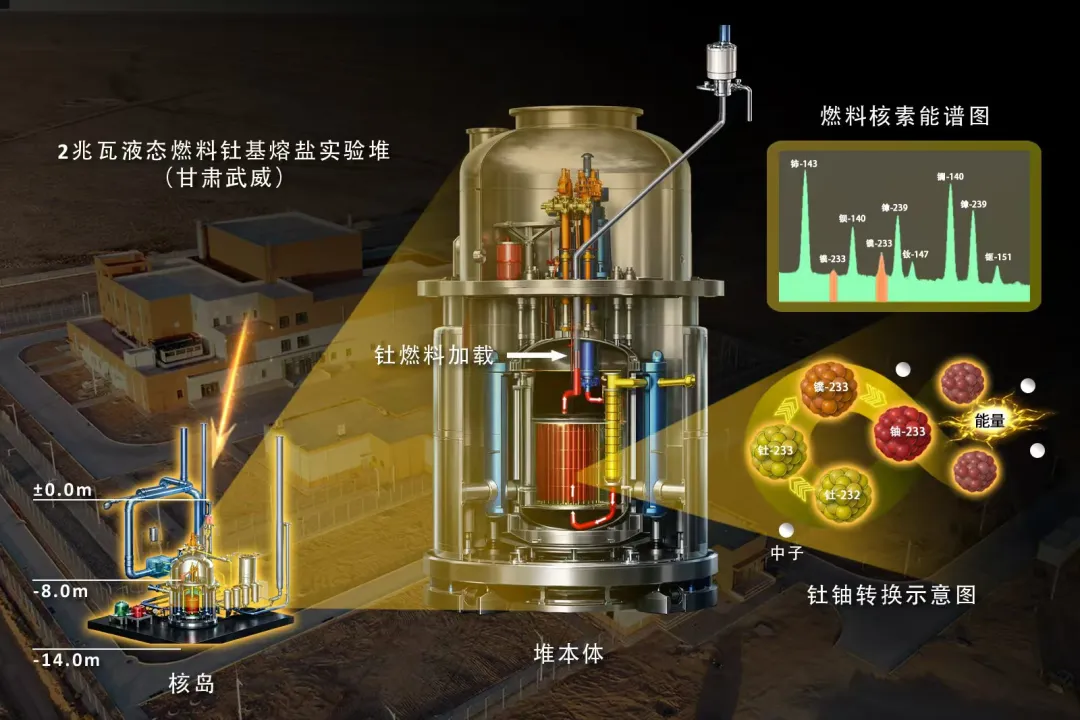
Experimental reactor structure, fuel nuclide spectrum, and thorium-uranium conversion overview released by Shanghai Institute of Applied Physics
Schematic of experimental reactor structure, energy spectrum, and conversion. Original image from the research institution, click to enlarge.
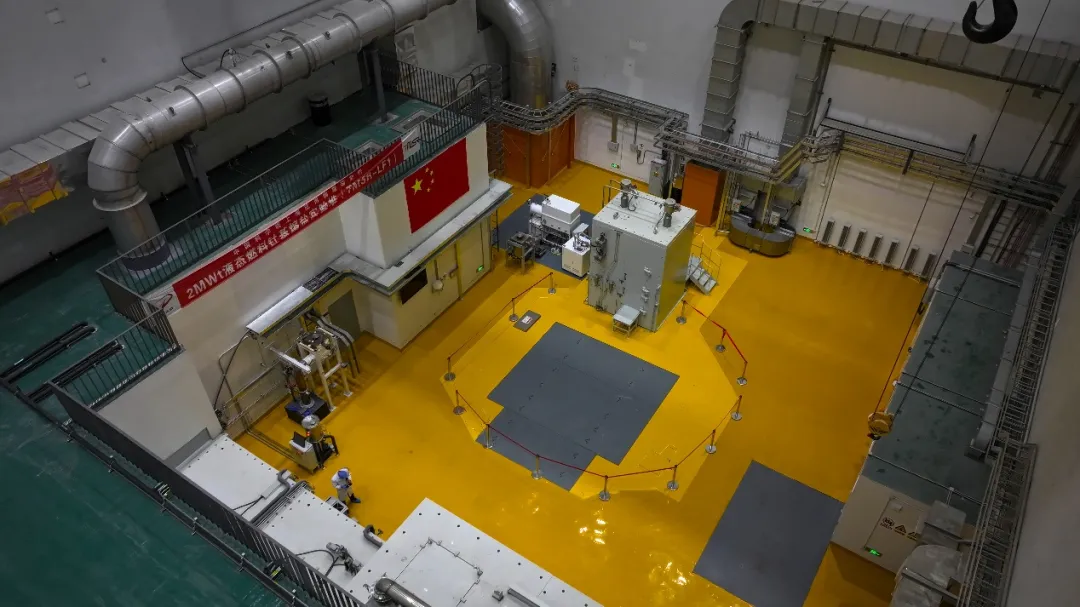
Actual scene of the 2 MWt liquid-fueled thorium-based molten salt experimental reactor hall in Wuwei, Gansu
Real view of the 2 MWt experimental reactor hall. Both images are from an article by the Shanghai Institute of Applied Physics on March 25, 2026.

Exploration and Route Adjustment

In addition to the reaction principles, consideration must also be given to whether the materials, equipment, manufacturing, and safety can be achieved.

Restart the special project

From theory, materials, and equipment, step by step to the experimental reactor.

Experimental results confirmed

2025 report on thorium-uranium conversion; March 2026 selected for the 2025 "Top Ten Scientific Advances in China."List of funding committee ↗

Already achieved: verification of thorium-uranium conversion in the experimental reactor, obtaining direct evidence of key nuclide changes.

This confirms the scientific feasibility of the fuel cycle route. Issues like material lifespan, larger scale, long-term operation, and economics still need to be addressed through engineering and operational results. The "t" in 2 MWt stands for thermal power; this is not a 2-megawatt electrical commercial power plant.

Thorium does not burn directly: nuclear transmutation comes first

Fission of uranium-233 can release energy. A fissile material is also needed to start and sustain the system. Thorium-232 is itself radioactive, so it is incorrect to say that thorium is non-radioactive or that adding thorium alone will generate electricity. This simplified diagram shows only nuclide conversion; it does not show the timing, proportions or a specific fuel process. IAEA: Thorium fuel-cycle conditions and challenges ↗

Keep the heat sources of the three systems distinct: tower-type concentrated solar power uses sunlight; the molten-salt nuclear reactor discussed here and the Fukushima BWR use nuclear fission. Molten salt is a class of material, not a single fuel or safety rating.

First separate operating conditions, then discuss hazards

At which step does the risk appear?

Switch operating conditions to see what each type of reactor needs to guard against. Arrows indicate pathways, not probability, release amount, or time proportion.

Normal operation: both types of nuclear facilities need to control radioactive materials

BWR · Water-cooled, solid fuel
Fission products generated in fuelFuel cladding and multiple barriersGas and liquid effluent treatment and monitoring

Normal discharge is constrained by nuclide concentrations, total amount, and regulatory limits. Normal cooling water cannot be equated with accidental contaminated water.

Liquid-fueled thorium-based molten salt reactor
Radioactive materials are distributed in systems such as fuel saltSalt circulation, off-gas treatment, and containmentMonitor tritium, gases, and possible leaks

Salt retains many fission products; off-gas, tritium, etc. still need separate management. “Using thorium” does not imply zero emissions.

Under this operating condition, based on reactor type alone, it is not possible to determine which has a lower actual environmental dose.According to S1

After shutdown, both reactors still have decay heat

Fukushima 2011 · Accident chain that has already occurred
About 7 MPaNormal operating water pressure · about 70 times standard atmospheric pressure
Shutdown after earthquakeTsunami destroys power supply and coolingResidual heat accumulation, fuel and barrier damageHydrogen generation, explosion, and radioactive release

This is a summary of the Fukushima accident unit; the hydrogen explosion is a chemical explosion. The factor of about 70 is just a pressure conversion, not a risk multiplier.

Liquid-fuel molten salt reactor · design mechanisms that can be modified
Can approach atmospheric pressureFuel salt circuit, still a high-temperature system
Reactor shutdown, residual heat still needs to be continuously removedLow pressure reduces pressure-driven releaseSalt retains many fission productsCooling, collection, off-gas, and containment still need to be reliable

Some designs use natural circulation or salt drain cooling. Leakage, corrosion, and loss of heat dissipation still need analysis and testing.

Clear judgment:Low pressure and salt retention are advantageous conditions for molten salt reactors; whether the overall plant accident risk can be further reduced still needs to be verified with specific designs.S1 §3.1 ↗ · Fukushima accident S2

After use, both types of nuclear facilities leave management responsibilities

BWR
Spent fuel, activated or contaminated equipmentCooling, shielding, classification, and storageLong-term waste disposal

The Fukushima accident also involves fuel fragments, cleanup waste, and long-term decommissioning work.

Liquid-fueled thorium-based molten salt reactor
Waste salts, treated waste, and irradiated equipmentTreatment, encapsulation, shielding, and storageLong-term waste disposal

Waste volume and long-term hazards depend on the fuel cycle and treatment route; using 'thorium' cannot be said to produce no nuclear waste.

To determine whose long-term burden is smaller, we need to clarify capacity, fuel cycle, waste composition, and evaluation time.According to S1 · S2

Likelihood of occurrence ≠ consequences after occurrence

Hazard magnitude cannot be judged by the reactor's name alone

How much is insideTypes of nuclides, inventory, operational history
How much comes outFailure process, barriers, and release fraction
How it reaches humans and the ecosystemWind, water, food, and protective actions

Fukushima has real contamination and long-term cleanup records; the low pressure and retention advantages of molten salt reactors provide directions to reduce some releases. To compare consequences, specific release quantities and exposure assessments are still needed; 'has happened/has not happened' cannot replace probability calculations.

Solar thermal, nuclear energy, and natural ecology

Beyond power generation, how will this place change?

Solar heating does not have pollution sources from nuclear fuel fission. This is a clear advantage. When evaluating the entire plant, habitat, water use, wildlife, materials, and decommissioning must also be examined. Below, comparisons are made according to impact pathways, without ranking installations of different scales and sites into a simple order.

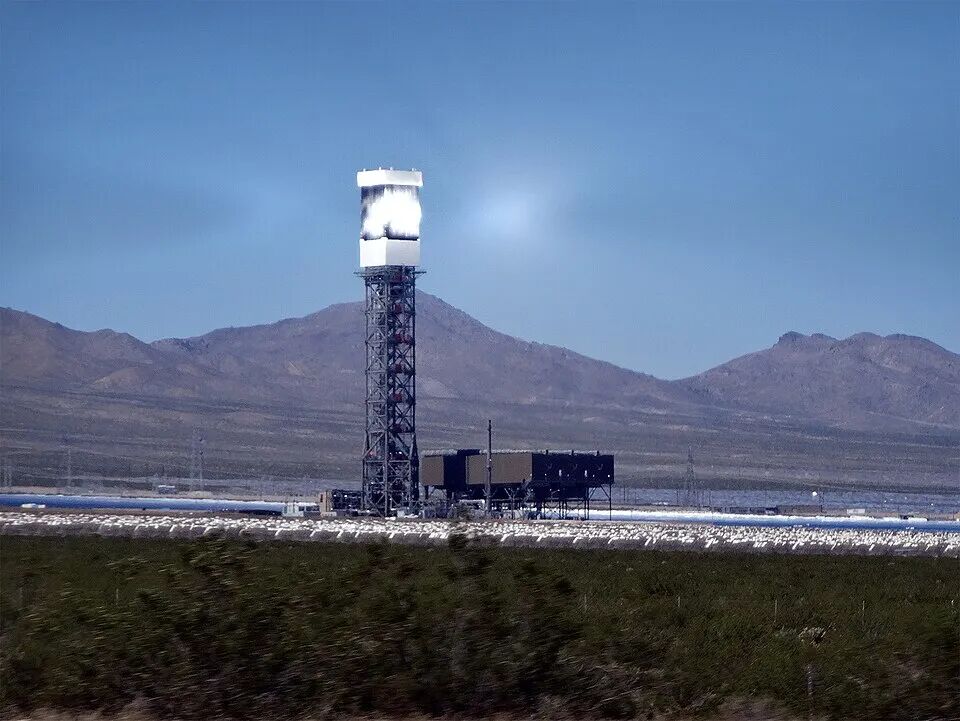
Real photo of the Ivanpah power plant, glowing absorbers and desert mirror field
Ivanpah, direct steam tower solar thermal, no molten salt storage. Photography by Craig Dietrich, forwarded article labeled CC BY 2.0;Original image entry · License descriptionThe local article retains the original image, not redrawn.

Ivanpah and Guazhou cannot be combined into one system

QuestionIvanpahGuazhou case
What is done on the tower?Concentrated sunlight directly produces steamConcentrated sunlight heats molten salt
Is there molten salt storage?NoYes; reports give 6 hours of designed storage
What can storage solve?This project has no such sectionUse part of the heat collected during the day when needed
Can ecological assessment be skipped?NoAlso cannot; storage does not eliminate the impacts of concentration, land use, water use, etc.

The parameters for Guazhou are taken from the CCTV report on July 16, 2024, and follow the verified cases from the teaching materials; these are not uniform indicators for all CSP projects. The capacity of Ivanpah differs in various materials due to gross power and net power definitions; this lesson does not mix capacity values.

Begin the investigation from three impact pathways

The air through which birds fly

The high flux of tower concentrated sunlight may damage feathers and tissues; collisions are also a pathway to investigate. Not every bright spot in the air should be classified as a bird, and the estimated total mortality should not be referred to as individually confirmed burn cases.

The ANL/NREL review simultaneously simulated the flux distribution of molten salt tower plants. Therefore, the addition of thermal storage cannot be used as evidence that "bird risk disappears."

Original habitat

The heliostat field, construction roads, and fences may alter habitats and passageways. The protection of desert tortoises in the Mojave Desert is an issue that must be addressed when siting and constructing Ivanpah.

Ecological improvement must consider local species, vegetation and surface conditions, and whether water and passageways are restored; just showing green areas or neat lawns is not enough to prove that the original ecology is protected.

Local water

The 2010 environmental assessment of Ivanpah adopted an air-cooling scheme, but there are still needs for mirror cleaning, feedwater for the steam system, etc. Dry cooling can reduce some water use, but it does not mean the entire plant requires no water.

When comparing, consider where the water comes from, whether the area is water-scarce, the amount of water intake versus consumption, and the trade-offs among cooling method, performance on hot days, and electricity demand.

Compare three routes using the same set of questions

What to compareCSP + molten salt storageFukushima accident unit · BWRLiquid-fueled thorium-based molten salt reactor route
Heat source and radioactive materialSolar heating; no nuclear fuel fission, does not produce fission products along this pathway.Fission of solid nuclear fuel, requires continuous management of radioactive materials.Nuclear fission in fuel salt; the thorium route also produces radioactive materials.
Accident contaminationNeed to prevent leaks of high-temperature salts, chemicals, etc.; not equivalent to nuclear accident release.The 2011 accident had records of uncontrolled radioactive release and long-term contamination management.Low pressure and salt retention of many nuclides have mechanistic advantages. Corrosion, residual heat disposal, containment, gaseous and mobile nuclides still need analysis and cannot have accident probabilities given by general principles.
Birds and terrestrial habitatsConcentration, collisions, mirror fields, and land use for roads, fences, and habitat connectivity need assessment.Construction sites, power transmission, and upstream fuel mining also impact habitats; do not have bird-harming pathways from mirror field concentration.Similarly, construction, transmission, and upstream material and fuel chains must be assessed; cannot infer the total land use and impact of commercial systems from experimental reactor scale.
Water intake and heat dissipationWater demand varies with cooling and cleaning schemes; dry cooling does not mean zero water use.Impacts of condenser water intake, interception, or suction of aquatic organisms, thermal discharge, etc., need site assessment; separate from accidental radioactive release.Not using water as the main coolant of the reactor core does not mean the plant uses no water. Electricity conversion and final heat dissipation schemes determine much of the water demand; cannot just look at the reactor core.
Materials, waste, and decommissioningMirrors, metals, thermal storage salts, etc., need maintenance, recycling, and disposal; soil and local habitats need restoration.Spent fuel, radioactive waste, and decommissioning; accident sites also require fuel fragment recovery and contamination management.Spent fuel salt, contaminated or activated materials, waste gas treatment media, etc. still need to be managed; the specific amount, type, and disposal of waste depend on the design and fuel cycle.
Long-term effects on humansConsultation with communities regarding land, water resources, and electricity supply; ecological damage may also affect livelihoods.Fukushima includes evacuation, return, psychological stress, livelihoods, and trust rebuilding, and cannot be assessed solely by radiation dose.Requires specific safety justification, operational verification, independent review, and long-term liability arrangements; the absence of commercial-scale accidents does not mean the probability of accidents has been proven lower.

How to make fair comparisons:Explain the lifecycle boundaries per unit of net electricity delivered to the grid, while considering the supply period, storage or regulation needs, site location, and ecological sensitivity. Separate water intake from actual consumption. One cannot directly compare the total water consumption or total waste of a small experimental reactor with that of a commercial power plant and judge which is better.

What are scientists and engineers already trying?

  1. First, avoid places that should not be built on.Identify important habitats and animal corridors, and prioritize evaluating sites with existing disturbances and lower conservation value.
  2. Modify the design, then examine the results.Preserve corridors and local vegetation, assess water for cooling and cleaning; for tower-based solar thermal, also study mirror alignment during operation and standby to avoid unnecessary high flux concentration.
  3. Use monitoring to verify commitments.Compare before and after construction with control sites, considering factors such as season, migration, detection and removal of carcasses; continue to adjust based on results.

AI cameras: first figure out how birds use the site

The Argonne team studies bird behaviors such as flying over and perching at photovoltaic power plants. DOE's 2024 report states that in over 17,000 hours of collected video, no collisions were detected, but the study sites were limited, and the team clearly indicated that further investigation is needed.

This case shows that AI can help with long-term observation and also indicates that 'not detected' needs to specify the scope. It isphotovoltaicresearch and cannot be taken as proof that Ivanpah or all tower-type concentrating solar power systems cause no harm.Research introduction and original video ↗

Leaving a path for land tortoises

The FWS-introduced small-scale photovoltaic pilot in Nevada retains vegetation, raises panels, provides openings in fences, and monitors wildlife usage. Land tortoises and others were recorded passing through, but there is still an impact, and application to larger sites still needs verification.

It provides verifiable mitigation measures, but planting vegetation alone cannot be taken as fulfilling ecological protection.FWS pilot records ↗

Speaker reference: How should one read the headlines '6,000 birds' and 'It's going to cool down'?

Verified against original materials; see publicly available sources listed on this page.

CPUC final decision E-5429 was passed on December 4, 2025, and released on December 10, rejecting PG&E’s submitted relevant early termination agreement, and the rejection does not prevent resubmission. It cannot support the claim that 'the power plant has already shut down,' nor can it replace subsequent status inquiries. This lesson does not use commercial shutdown rumors to prove that a technology must fail.

Sources for ecological comparison

  1. . Used for problem and case entry; quantitative conclusions need separate verification.
  2. DOE: Ivanpah project steam route(historical project introduction);SolarPACES: Direct Steam, No Thermal Storage, and Solar Flux Study
  3. ANL/NREL 2015 Review of Bird Monitoring and Mitigation / Local PDF · Original PDFChapters 2, 3, 5: Impacts, Monitoring Limitations, and Molten Salt Tower Solar Flux Simulation.
  4. DOE/BLM: Ivanpah 2010 Final EIS, Construction and Cooling, Water, Ecological Plan; This is an EIS document, not actual operational measurements.Revised Biological Assessment
  5. EPA: Effects of Cooling Water Intake on Aquatic Organisms. Applicable to intake systems, with specific extent depending on site and engineering plan.
  6. FWS: Wildlife-Friendly Photovoltaic PilotDOE: Argonne AI Camera / 2024-10-24. Both are photovoltaic cases.
  7. CPUC Final Decision E-5429 / 2025-12, Only used to verify early termination agreement events mentioned in the article.
  8. Nuclear mechanisms and consequences follow pages S1, S2, S3, S4; Guazhou follows the main lecture slides, verified with CCTV materials and sources. The three-route comparison is a qualitative synthesis by AHALab based on these materials, not a statistical risk ranking.
MSRE, LFTR, IMSR, and China TMSR—are they the same thing?
NamesUsed to understand whatEvidence and Boundaries
MSREHistorical experimental reactor at Oak Ridge, USA: liquid fuel can operate in a molten salt system.Operated from 1965 to 1969; used uranium-233 in 1968. This is not China’s 2025 in-core thorium-uranium conversion experiment.ORNL historical records ↗
LFTRFamily of liquid fluoride salt reactor concepts utilizing the thorium-uranium cycle.The 2017 translation discusses principles, advantages, and vision. Specific designs like dual-fluid and salt drainage do not represent all molten salt reactor configurations.
IMSRThe engineering idea of integrating the reactor core, main pump, heat exchanger, etc., into modules and transferring heat through independent loops.The first reactor plan in the 2017 article used low-enriched uranium and is not synonymous with thorium reactors. Construction time was the target at the time, and the title alone does not indicate commercial power plants were built.
TMSR-LF1China’s 2 MWt liquid-fueled thorium-based molten salt experimental reactor advances material, system, and thorium utilization verification.2025 report on in-core thorium-uranium conversion, with annual progress recognized in 2026. Experimental results represent actual progress; commercialization and full-lifecycle safety require subsequent evidence.Reported by Shanghai Institute of Applied Physics ↗

Design pre-review, construction permit, operating license, and commercial operation are different stages. The Canadian Nuclear Safety Commission states that vendor design pre-review is neither design certification nor a license.CNSC original statement ↗

Expand the full 11-dimensional comparison: heat source, pressure, pollution, waste, and impact on life
Comparison dimensionsFukushima accident unit · BWRLiquid-fueled molten salt reactor
Heat source and fuelNuclear fission in solid fuel; in-core water serves as both coolant and moderator.This page is limited to the route of dissolving nuclear fuel in salt. Different fuel cycles can be used, and the thorium route is just one of them; fission products will also be generated.Basis: S1, S2
Pressure and Leak DynamicsThe in-pile operating pressure is approximately 7 MPa. Safety analysis focuses on important scenarios such as pressure boundary failure, water loss, and obstruction of water replenishment.The fuel salt circuit can operate close to atmospheric pressure, reducing the force driven by pressure release; however, there are still issues with high temperature, pumping, exhaust gas, and local pressure.Reference: S1 §3.1 / S2 Box 2.1
Reactor Shutdown and Residual HeatShutting down the reactor can stop the ongoing chain reaction, but it cannot immediately eliminate decay heat; reliable cooling and a final disposal of the heat are still required.Residual heat must also be discharged. Some concepts use negative temperature feedback, natural circulation, or discharge of salt into a cooling container; applicability and reliability need to be verified according to the design.Basis: S1, S2
Mechanism of serious accidentsAfter the Fukushima earthquake, the reactors were shut down. The tsunami caused power and cooling failures, leading to severe fuel damage. High-temperature zirconium-steam reactions produced hydrogen, resulting in chemical explosions and radioactive releases.The typical liquid fuel fluoride salt route changes the accident mechanisms of solid fuel rod melting and zirconium–steam interactions; it still requires analysis of salt leaks, cooling failures, reactive anomalies, off-gas, and chemical issues.Basis: S1, S2
Normal operating effluentControlled gaseous and liquid discharges from the operation of nuclear facilities must be treated, monitored, and subject to regulation. Normal operating conditions and accident conditions should not be treated as the same type of discharge.Fuel salt, off-gas treatment systems, and related circuits contain radioactive substances; tritium may migrate and requires containment and monitoring. Low pressure does not automatically eliminate effluent.Basis: S1, S2
How pollution reaches the environmentAfter fuel is damaged, radioactive gases, particles, and contaminated water may breach barriers and enter air, soil, water, and food pathways.Salt can chemically retain many fission products, potentially reducing some releases; effectiveness depends on nuclides, salt chemistry, and operating conditions. Leaked salt and volatile substances still need containment.Basis: S1, S2
Waste and decommissioningSpent fuel and contaminated or activated equipment require long-term management; the Fukushima accident also left fuel fragments and a large amount of cleanup-related waste.Waste salt, off-gas/chemical treatment waste, and irradiated equipment still need management. The quantity of waste, long-term radiotoxicity, and treatment burden differ across cycles and cannot all be classified as 'non-nuclear waste.'Basis: S1, S2
Magnitude and duration of environmental consequencesThere are existing actual contamination, cleanup, and monitoring data. Impacts depend on nuclides, release amount, migration, exposure pathways, and protection; radioactive decay and environmental migration together affect the time scale.Evaluation should be based on the inventory of radioactive material in the specific design, the proportion released in an accident, barrier capabilities, and the site. Without specifying these conditions, a unified impact radius or duration cannot be provided.Basis: S1, S2
Human living conditions and healthEvacuation, return, psychological stress, livelihood, trust, and long-term governance should all be considered. Attribution of radiation health effects depends on dose and epidemiological evidence, see the dedicated explanation below.Potential contamination accidents may similarly affect evacuation, livelihood, and trust. Design advantages cannot replace emergency preparedness, information disclosure, occupational protection, and waste disposal responsibilities.Reference: S2, S3
Likelihood of contamination occurringFukushima was an accident at a specific site, time, reactor units, and disaster combination. BWR technology has a long operational record; a single accident cannot represent the probability for all modern nuclear power plants.Low pressure and salt retention characteristics can reduce some accident-driving factors; the reliability of materials, monitoring, components, operation, and containment needs to be verified. The accident probability of a commercial reactor cannot be inferred from "the experimental reactor has operated."Basis: S1, S2, S4, S6
Comprehensive judgment: what is still lackingClearly identify the design, upgrades, site, operational management, radioactive inventory, and consistent evaluation criteria of the units being compared.Also clearly specify the specific design and scale, then compare independent safety analysis, tests, and operational evidence. No percentages or "safety multiples" are provided here, because there is no probability study with consistent criteria to support it.Basis: Course comparison method based on the above information

Three easily confused points

"No detected radiation health impact" is not the same as "the accident caused no harm."

The UNSCEAR 2020/2021 report reviewed data up to the end of 2019: no health damage of Fukushima residents could be directly attributed to radiation from the accident, and any increase in radiation-related cancer is unlikely to be detectable at the population level. This conclusion is limited in terms of subjects, attribution, and statistical detectability; it does not mean the individual risk is zero, nor does it deny contamination, evacuation, livelihood, and psychosocial damage. The parts jointly affected by the earthquake, tsunami, and nuclear accident cannot be simply attributed to any one of them.

Basis: S3; social and psychological effects see S2.

Accident releases, ALPS-treated water discharge, and cooling water are three separate issues.

Uncontrolled radioactive releases in the 2011 accident are not the same as controlled ALPS-treated water discharges starting in 2023, nor are they the same as normal condenser cooling water from a power plant. In July 2023, the IAEA evaluated the controlled, gradual discharge plan under review at that time: under the corresponding plan and safety conditions, radiation impact on humans and the environment is negligible. This assessment does not prove that the 2011 accident caused no contamination, nor can it replace ongoing verification of each batch's treatment effectiveness, radionuclide concentrations, discharge volumes, and environmental samples.

Concerns should be taken seriously and heard. In class, questions can be asked: Who conducts the inspections? Can the data be verified? How is the process stopped in case of anomalies? Who handles the losses for fisheries and residents?

Reference: S5. This is the conclusion of the 2023 plan review and does not claim to have verified each batch of emissions up to 2026.

'Thorium', 'low pressure', 'experimental success'—what does each indicate?

Thorium-232 is not a fission fuel capable of sustaining a chain reaction on its own; it requires nuclear conversion and cooperation with fissile material. The thorium cycle will still produce radioactive substances. Low pressure reduces one type of release force but cannot replace corrosion control, residual heat removal, or containment systems. In China, for the 2 MWt experimental reactor, 't' indicates thermal power and should not be written as 2 MW electric power. Experimental results require further engineering verification before evaluating larger-scale and long-term operation.

Reference: S1, S4, S6.

Original data

The main course slides and this page can be read offline. Two full IAEA reports have been saved locally; other links are for online verification.

  1. S1 · IAEA · Status of Molten Salt Reactor Technology(2023)
    Original source ↗ · Local report PDF
    Chapter 3: Potential advantages of low pressure and radioactive substance retention, as well as R&D challenges in salt chemistry, materials, and safety analysis; PDF pages 24–33.
  2. S2 · IAEA · The Fukushima Daiichi Accident(2015)
    Original source ↗ · Local report PDF
    Accident units, the principle of boiling water reactors, loss of cooling after shutdown, radioactive release, and recovery operations. BWR around 7 MPa see Box 2.1, PDF page 38.
  3. S3 · UNSCEAR · Fukushima 2020/2021 Report Q&A
    Original source ↗
    Scientific attribution of residents’ radiation health effects; the 2020/2021 report reviewed data up to the end of 2019. The lack of detectable impact in the population cannot be interpreted as the accident having no other damage.
  4. S4 · National Nuclear Safety Administration · Supervision and inspection of a 2 MWt thorium-based molten salt experimental reactor (2020)
    Original source ↗
    The project is clearly defined as a 2 MWt liquid-fueled thorium-based molten salt experimental reactor. MWt refers to thermal power; this historical review is used to confirm the nature of the project and is not intended to describe the operational status in 2026.
  5. S5 · IAEA · Review of ALPS Treated Water Discharge Plan (2023-07-04)
    Original source ↗
    Provided a conditional radiological impact assessment for the controlled and gradually implemented discharge plan under review at that time, and committed to ongoing independent verification.
  6. S6 · IAEA · Molten Salt Reactor Material R&D Workshop (2026)
    Original source ↗
    Agenda for materials, corrosion, salt chemistry, and multiphysics analysis research in 2026. Used to illustrate engineering issues that still need verification; the meeting agenda is not regarded as performance validation.

Supplementary reading: which content was included in the presentation?

Explaining why the research direction changed from the "Project 728"

"Premier Zhou and the Molten Salt Reactor History of 'Project 728'" was published on February 18, 2026, and is a historical narrative. The presentation uses the research route, industrial foundation, and long-term exploration as the narrative thread, combined with verification from research institutions; it does not take the sender's workplace as a guarantee for all details of the article.

· Researchers' review ↗

Using real experiments and original diagrams to illustrate today's achievements

The article from Shanghai Institute of Applied Physics on March 25, 2026, provided conversion experiments, key nuclide evidence, and research route explanation. The selected news is consistent with the announcement of the National Natural Science Foundation on the same day. The above two original diagrams are taken from this article. The following two Feishu links are the same document and are not counted as two independent pieces of evidence.

· · List of funding committee ↗

Using two articles from 2017 to compare design concepts and the goals at that time

The IMSR article is used to understand integrated modules and multi-loop heat exchange; the LFTR article is used to understand liquid fuel, low pressure, and historical choices. Both are popular science or compiled materials from the year. The commercialization schedule, cost estimates, or ideal fuel cycle waste curves in them cannot be directly treated as actual performance in 2026.

· ·

For instructor reference: No verbatim expressions from the old text are used.
  • Thorium radioactivity:Thorium-232 is radioactive. 'Thorium is a non-radioactive element' is not used.IAEA Thorium Fuel Report ↗
  • Nuclide names:Thorium-233 undergoes β decay first to protactinium-233, then to uranium-233; do not write protactinium as uranium, or describe a thorium blanket as uranium-232. Atomic numbers 90, 91, 92 correspond to thorium, protactinium, and uranium, respectively.
  • Historical dates:The reactor operation period of MSRE is written as 1965–1969 according to ORNL records, to avoid errors in old texts such as '1069' and 'five continuous years of operation'.ORNL ↗
  • Safety and waste:Do not use absolute conclusions like 'zero pollution', 'forever safe without any intervention', or 'waste only stored for a few hundred years'. Conditions such as the specific salt, nuclides, operating conditions, processing routes, and heat removal need to be considered.IAEA Advantages and Challenges ↗
  • Commercialization:The IMSR 2017 construction plan is not evidence of completed construction or granted operating license; this scheme is not directly applied to Chinese experimental reactors.Pre-assessment vs. Licensing ↗

These materials were collected into Feishu on September 11, 2026; the collection date is not the date of the article or experiment. Original text and images retain sources and are included only as local classroom review materials.