Yesterday, Guancheng Town.
Today, try to do early warning.
The same question, think again from the researcher’s perspective: if you want to predict whether the river will rise, what would you collect first?
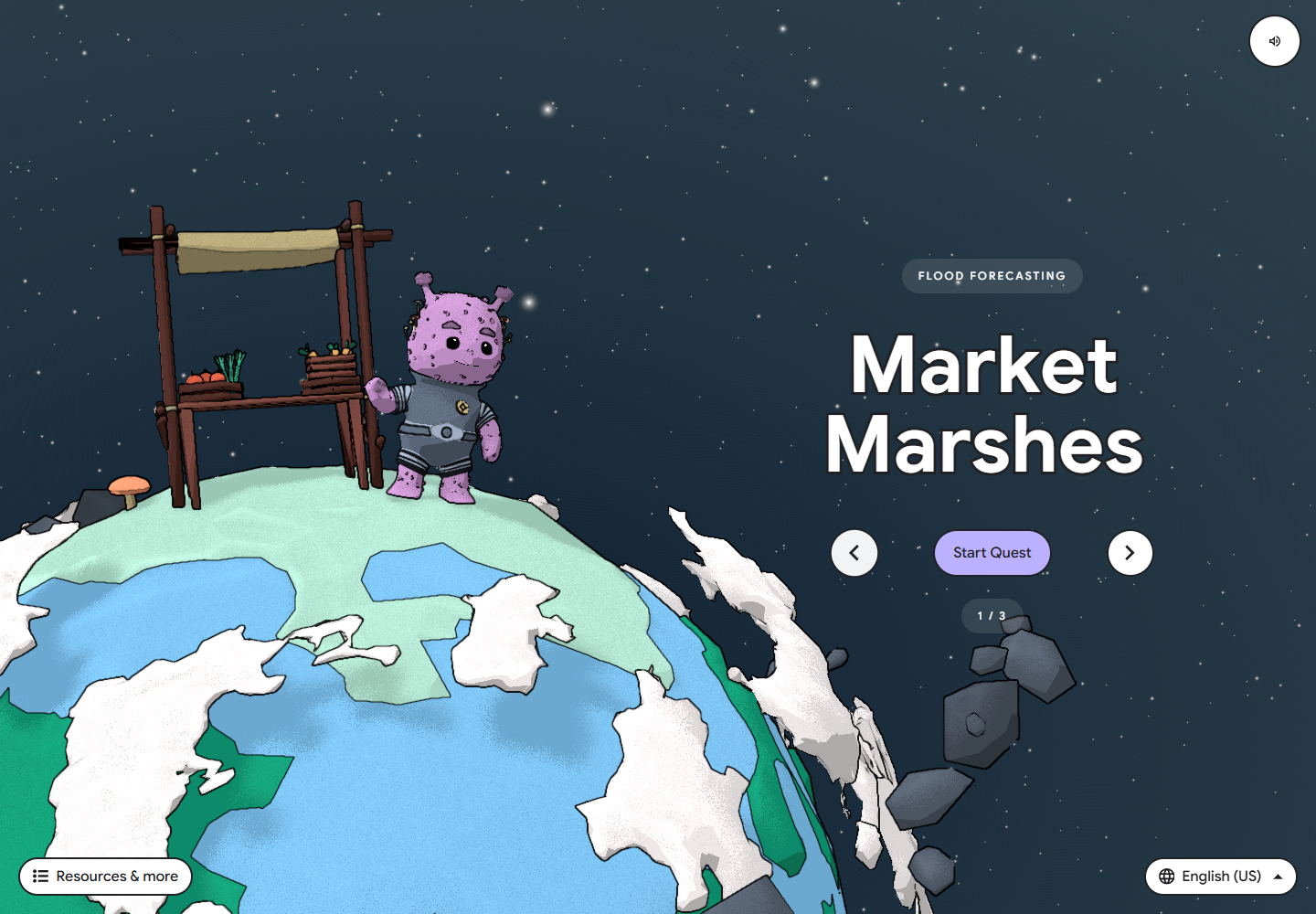
Which task will we take?
Market Marshes / Flood prediction.First, help the market understand flood risks, then consider how to turn observation data into useful information.
Developed jointly by Google Research and Stanford Accelerator for Learning for ages 11–14. It lets users make choices, see feedback, and revise their ideas.
Original English version; current language menu does not include Chinese. No login required, internet connection needed. The following Chinese tutorial is written by AHALab, not the official localization.
8 minutes, focus on just two key choices
Which data to choose? What to use for testing?
Four groups first explain their reasons, then look at the illustrations. Teachers can use the steps prepared in the original version; projection of the field test screenshots below also works. This discussion will not train the real Google flood model.
| Time used | Do it together as a class |
|---|---|
| 0–1 minute | Recall a decision from yesterday: If we could know in advance how high the river water would rise, what would we change? |
| 1–4 minutes | Each group proposes one type of data and explains its relation to flooding. First write it down on paper, then proceed to the next section. Don’t just say "the more data the better." |
| 4–6 minutes | Check the original segment and discuss data gaps. The model performs well on questions it has seen, is that enough? What data should be left out before testing it again? |
| 6–8 minutes | Each group adds one sentence: "To make this warning reliable, we also need to check…" then return to the weather model. |
Step One: After finishing your choices, look at the original scene again
What kind of data do you want to find? Why?
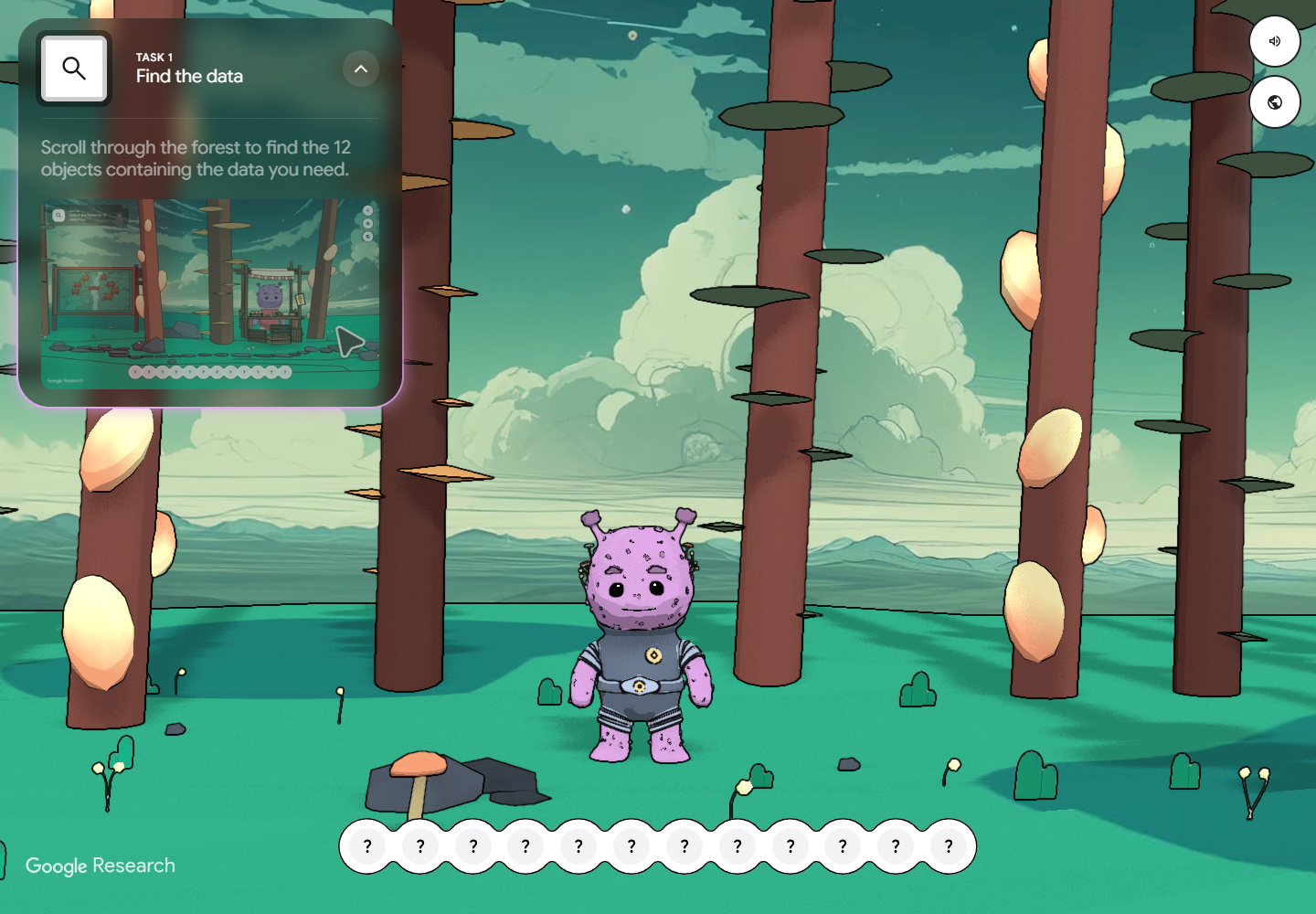
Discussion prompts: Rainfall, river water level or flow are directly related to flooding. Also ask where observations come from, how long they have been recorded, and whether there are missing values. Topography and the affected population are also worth investigating; don’t mix all useful information into the same model input.
Step Two: Give the model a question it hasn’t seen before
If a dataset has never recorded a flood, can you trust it to predict floods?
"Answering correctly on data it has already seen" and "being able to judge unseen cases" are different. Reserve data not used in training to check false positives and false negatives, especially for rare major floods. Discuss one gap, then explain how you want to test it.
This is an AHALab extension question. Game feedback only shows performance in the game; real-world predictions need continuous validation by actual observations.
Connect the results to real research
What we just did was a teaching task. Next, let's look at Pangu, GenCast, Aurora, and Earth-2: what data do they face, and how do they evaluate the results? Finally, someone still needs to receive alerts and make decisions.
Back to the four weather tools →How to prepare before class
- Use the classroom computer and network to open the original version, click 'Accept mission,' enter task selection, choose 'Market Marshes,' then click 'Start Quest.'
- Go through the opening dialogue before class and pause the page at the data section. Menu items can be interpreted by the teacher; do not let English reading speed determine who can participate.
- The default is one teacher computer plus projection. Each of the four groups has reasons; switch groups for each response. When there are four computers, also first specify which part of the task to complete in this session.
- If it fails to load before class, just use the local screenshots on this page. If it still does not enter after about 30 seconds of on-site attempts, also continue with this page.
The local version retains screenshots, questions, and instructor prompts and can be opened offline; the Google webpage original version cannot be played offline this way, nor does it guarantee game progress is retained across devices.
Want to complete this task fully?
Flexible Quest: Market Marshes This is the single-player projection adaptation provided by Google, recommended for 30–45 minutes. You can open another special session to let the whole class experience the complete task and review it; this lesson’s 8 minutes is just a segment for play.
The official website also has Dusky Dunes for preventing blindness, as well as extended resources like canopy, buildings, wildfire, etc. You can continue choosing based on the issues you care about; you don't have to play all tasks at once.
Sources and usage records
- Google Research: AI Quests original version
2026-09-11 Test: Can enter English flood tasks without login; Chinese language menu not found.
- Google: Release notes
Jointly developed by Google Research and Stanford Accelerator for Learning, aimed at ages 11–14; Tasks involve data preparation, training, and testing.
- Google: Teacher resources
Includes task manuals, reflection materials, and extended classroom resources.
- Google: Flexible Quest projection classroom
Official projection adaptation recommends ages 9–15, 30–45 minutes; Suitable for classrooms with fewer computers or internet access.
- Google:FAQ
No name, email, or login required; Web games require internet access. The number of tasks and language plan in the FAQ lag behind the actual interface, so playable tasks are not judged based on this.
- Raspberry Pi Foundation: Incorporating Experience AI
The education partner has incorporated AI Quests into the Experience AI resource; This is a course adoption record, not an effect study for this 8-minute event.
Google and its partners provided the original tasks and teaching materials. The Chinese questions, 8-minute duration, and grouping method in this lesson were adjusted by AHALab and have not yet been validated in this class.